
Tandem


MANAGER, SPACE PLANNING & CORPORATE SERVICES, Tandem Diabetes Care
Project objectives
Establish a reliable source of truth for workplace occupancy
Replace manual bed checks, badge swipes, elevator data, and desk booking reports with objective, sensor-based evidence of how nearly 500 seats across four floors are actually being used.
Support workplace policy decisions with credible data
Give leadership the evidence base needed to revisit hybrid policies — including assigned seating and on-site attendance expectations — grounded in real usage patterns rather than disputed proxies.
Deliver transparent reporting for internal and external stakeholders
Provide facilities, department leaders, executive leadership, and the building landlord with consistent, defensible occupancy insights, including the quarterly reporting required by the lease.
Build a foundation for AI-driven workplace intelligence
Move beyond manual reporting by enabling natural-language analytics, unified floor maps, and a workplace platform that scales as sensor coverage expands from bookable desks to assigned seating.
Results of the cooperation
Spaceti partnered with Tandem Diabetes Care to bring data-driven decision-making to a hybrid headquarters where assigned seating, departmental space requests, and actual attendance had drifted out of alignment. With nearly 500 seats and daily on-site attendance closer to 200 employees, the facilities team needed a credible way to understand real usage — one that didn't depend on manual counts, badge data, or desk booking reports that only captured a fraction of the picture.
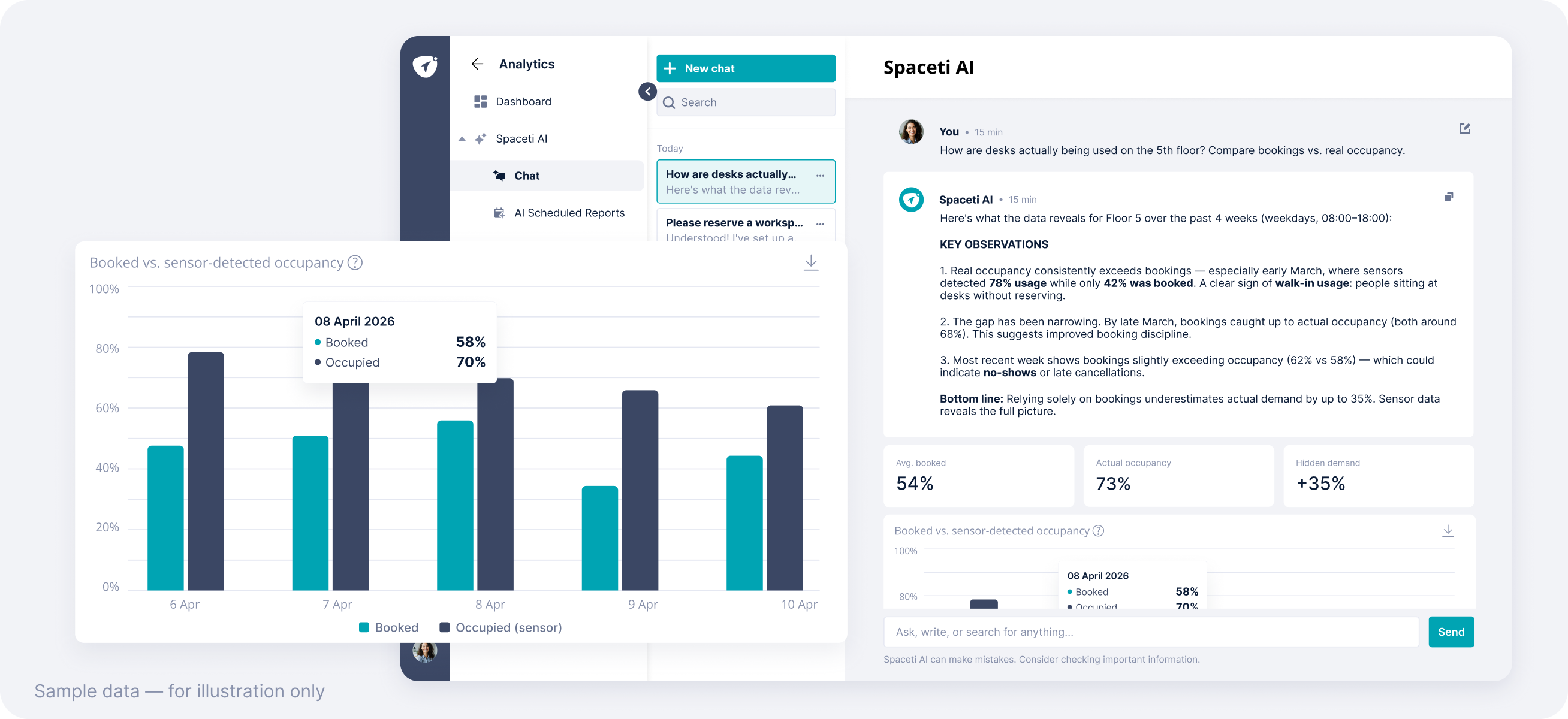
Today, Spaceti is deployed across three floors of Tandem's San Diego HQ, starting with bookable desks and on a roadmap to expand to assigned seating. Desk-level occupancy sensors now provide an objective source of truth, paired with workplace analytics, space planning tools, visitor management, and AI-powered insights that allow the facilities team to query workplace data in natural language instead of building manual reports.
Early findings have already challenged internal assumptions about which floors and zones are underused, giving Tandem the confidence to revisit hybrid policies and approach space allocation conversations — with department heads, leadership, and real estate partners — on a stronger evidentiary footing. As sensor coverage and historical data continue to grow, Tandem expects the platform to support increasingly precise decisions about desk assignment, space allocation, and workplace investment.
Key features


